I Predict...
We are all interested in the future, for that is where you and I are going to spend the rest of our lives--Criswell

As a follow-up to a recent column [experts] on whether grading a middling card is worthwhile given the costs, I realize that I did not discuss the question of future appreciation. Would the sunk cost of slabbing a lower grade card be justified by potential future appreciation? Let’s kick that around.
I am skeptical of sinking today’s exorbitant grading fees into a low to midgrade mainstream card in the hope of a ROI in the future. Obviously, this does not apply to a marquee card like a 1952 Mantle or a 1954 Aaron RC. Insanely high demand cards appreciate in every grade because people want them regardless of condition and I would not hesitate to send in even a beater. Hell, I have:
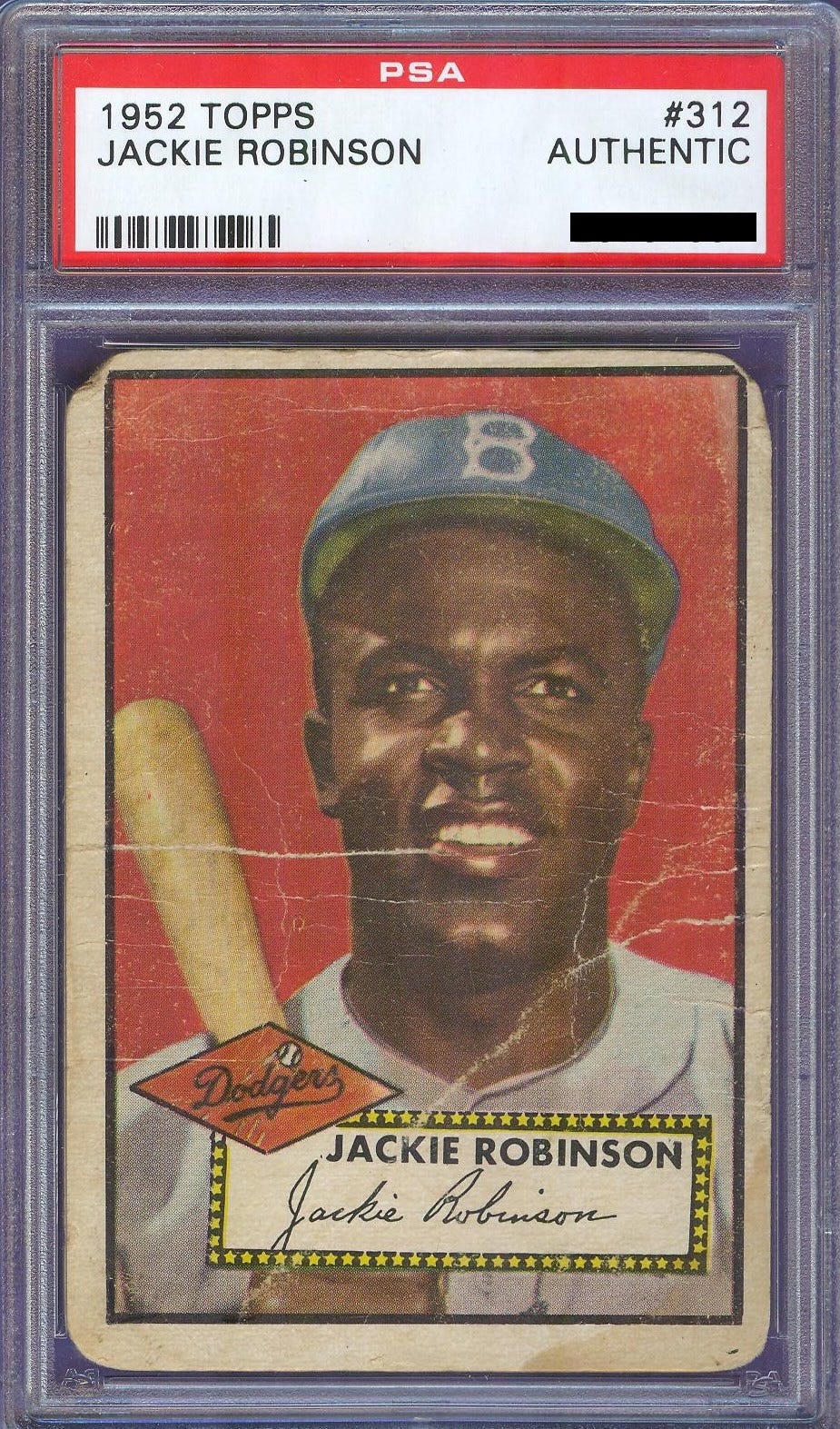
And I am very happy with the results, aesthetically and financially speaking.
I feel pretty safe in that position, but I cannot predict the future; I ain’t Criswell. Or a member of Congress. If I was, I’d be insider trading stocks right now instead of sharing time with you fine folks. What I do think is worth considering is this:
1. “You should never underestimate the predictability of stupidity.” —Bullet Tooth Tony: ignorance of grading standards is swelling the population of lower and mid-grade cards in slabs. Most people sending vintage cards in for grading simply are not competent to assess the condition of their cards accurately to determine whether it makes sense to grade them. The result is a ton of lower grades and disappointment. At Pasadena, a whole bunch of newbie collectors told me they planned to submit cards for grading that I can tell in a momentary review just will not achieve a grade sufficient to justify the cost of the service. I know one guy who spent thousands with PSA grading what he was sure was a find of near mint or better 1950s cards. He got back mostly 2-5 range grades and was just apoplectic over it. When he showed me the encapsulated cards and the hundreds of raw cards he still had that he said were comparable, I knew why: the cards were absolutely beautiful examples with mostly crisp corners and edges and booming gloss, great eye appeal, but there were technical flaws in all of them due to storage damage over the decades that would drive down a formal grade; a warped 7 looks fabulous bit grades a 2. Had he asked anyone with experience submitting cards before he sent them in, he would have been advised not to do it. What he ended up with were gorgeous low-grade slabbed cards not worth the sunk fees.
2. Evolving standards in grading has long been the case depending on who is running the TPGs. What is different now is the pace and inconsistency of evolution. They have sped up with the wave of expansions of TPG staff since COVID. G.O.D. [the Grader Of Death] has always existed at PSA; what has gone up as a result of the boom is the frequency and unpredictability of G.O.D.-like outcomes. I have been doing this a very long time. My prediction rate on my TPG submissions was about 90% within one-half grade of actual (there was usually a 1-in-10 wild grade or no-grade in there). Even with that level of experience, I am now surprised with every order I send in by at least 20% of the results, either way, regardless of which service I used, and the surprise margins are bigger. It seems that everyone hands me a few gift grades and a few Please Submit Again grades. I know players in the high-grade mainstream postwar card field with similar time in the game who have been shocked lately at the inconsistent grades they are getting. We are a small minority in the collecting community simply by reason of our decades as collectors, but we are bellwethers in terms of outcome. If we can’t get it right as often as before, it is a low odds crapshoot for collectors with less experience and skill at assessing cards to lay out $30+ to get a grade.
What this means overall is that there are a ton of low-grade and mid-grade slabs out there with a pop growing every day as suckers, er, customers send in more unworthy cards for slabbing on a hope and a prayer.
What does a growing pop of these cards mean over the long term? I think about modern cards as an analogy: with rare exceptions, the glut of slabbed cards with similar technical grades means in the long term is that all you will really compete on is price. While that effect is not as profound with vintage simply because time has worn cards differently in different collections and you don’t have thousands and thousands of identical looking cards for sale at the same time, it is a question of scale more than a difference of market dynamics. I had a very good example of that at the Pasadena show: I had a showcase full of postwar mainstream HOFers and superstars in lower grades marked to market. So did some other dealers. I did not sell one of them, but I sold several similar cards on REA’s marketplace at about 80%-90% of market over the same weekend. I could undercut eBay results and prices due to the lower commission at REA. Call me crazy but I do not want to be invested in something so commonplace that the only way I move things when I need to sell is to undercut the market, wherever the market price may be at the time. I want my long-term investment holdings to be items that are either objectively rare or very high demand (preferably both attributes in the same item) regardless of grade. I have some cards like that, and I am not exactly surprised whenever another example hits the auction block and the crowd goes nuts.
For my money, if I wanted to get low-to-mid-grade mainstream postwar cards in slabs, I would not submit them. I would shop for the cheapest examples of graded cards with the best eye appeal for the grade rather than bucking the tiger and sending in my own raw cards. In that regard, the market actually favors the experts because of the submitter ignorance I mentioned above. Disappointment is profitable. I don’t want to tell you how little I paid for that poor sucker’s inventory; suffice it to say that his sunk grading costs were far more than I paid for the entire collection, graded and raw, and I turned a profit on the deal at his expense.
Our eBay Jackass of the Week is of the ‘so stupid that I am scared that he drives’ variety. Simple set of facts: I sold a $15 card, eBay standard envelope shipping, it got lost in the mail. After we waited a few weeks past the due date for the card to show up, he PM’d me that it had not arrived and asked what to do. I told him:
“It’s lost. Please start a refund claim with eBay and I can then apply for an insurance reimbursement.”
Now, what would you do? File a claim for an item not received? Pretty foolproof, but the problem with fools is that they are so ingenious. How about instead of that you request to return the card you say you never got? Yeah, that’s the ticket! I receive a return request with this message:
“I semt a.return and you have to accept.”
Umm, how is he supposed to return a card he never received? My response:
“No, I do not. You cannot return an item you say you never received. You need to call eBay and explain that you never received it and opened the wrong kind of case by accident.”
Did he do that? Not so far.
I think I know what happened. The menu for a purchase has a “Return an Item” button but doesn’t have a single click button for “Item not received”. It does have a button for “Help and Report”, which is where you have to go to deal with an item that never arrived. Once you get to that page, it has a visual menu for “Need help with a recent order?” where you can pick your item and make a claim. I guess that was too much for Mr. Shitwit to manage, so he filed a false return claim instead. I declined the return and reported him for a misuse of returns.
Now, just in case you think I am being a dick about it, I would refund him for the loss—neither of us is at fault—but not if he kills my opportunity to use eBay’s shipping insurance to be made whole. The insurance won’t pay off if the item appears to have been delivered, and filing a return request means exactly that. I can’t and I won’t follow him down the rabbit hole of a false return narrative. The problem, of course, is that if I participate and accept a false return request, there is a spiraling set of absurdities and consequences that ensues. eBay generates a return shipping envelope for Mr. Genius to use. He has nothing to put into it. If he doesn’t ship back that tracked envelope, he doesn’t get a refund. When he figures that out, his next Sheldon Cooper-esque move no doubt would be to ship me an empty envelope or an envelope with a different card in it. I would then have to file a misuse of returns report with eBay due to my not receiving the item, and we dance on and on. See what I mean?